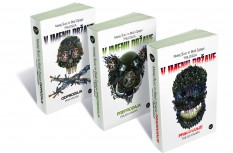
Journalists Matej Šurc and Blaž Zgaga investigated the illegal trade of arms in Slovenia during the early 1990s and chronicled their findings in the trilogy In the Name of the State, built largely on documents obtained through freedom-of-information legislation.
A trilogy built on official documents
The first volume, Sell, published in June 2011, focused on the sale of arms and ammunition. The second, Resell, appeared in October 2011 and dealt with the purchase of arms abroad and their subsequent resale to Croatia and Bosnia and Herzegovina during the UN arms embargo. The third, Cover-up, published in April 2012, described how the arms smugglers had managed to keep their activities largely concealed for two decades. The authors said the case had never been fully investigated before: some aspects had been touched upon, but the whole truth had not been revealed, and the affair tended to resurface only during electoral battles before disappearing again.
What the documents described
According to the authors, after being one of the most prosperous socialist states during the Cold War, the former Yugoslavia fell into military conflict, mass killings and war crimes in the 1990s. Many thousands of tons of arms and ammunition were illegally transported to the battlefields during the UN arms embargo, with Slovenia as the major logistics hub, selling arms confiscated from Yugoslav People's Army warehouses on its territory to Croatian and Bosnian buyers. More than 20 ships loaded with arms reached the Slovene port of Koper from Bulgaria, Poland, Romania and Ukraine, and the authors argued that an operation of such scale could only have been carried out with the approval of the international community.
Because the shipments were illegal, many Slovene, Croatian and Bosnian intelligence officers and leaders bought weapons on a black market controlled by military intelligence services operating outside the law, paying millions of dollars and Deutschmarks in cash. Large sums disappeared, and, according to the authors, the politicians, military and intelligence officers involved became wealthy members of a new elite who concealed their activities and corrupted the judicial systems of their countries. One consequence, they said, was that the region of the former Yugoslavia continued to resemble a "black hole" in Europe, marked by corruption and organised crime closely connected to politics.
Obtaining the records
The authors sought as many different types of documents as they could. The majority were classified police and secret-service cable messages and intelligence reports, but their databases also included port and shipping documents, ammunition warehouse releases, eavesdropping notes, police analyses, Interpol cables, bank-account information, parliamentary inquiry reports, witness hearings, diplomatic cables and reports from international conferences on Yugoslavia. They credited Croatian and Bosnian colleagues Saša Leković and Ecad Hecimovic with helping to obtain and analyse the material. The mechanics of pursuing such requests across borders are set out in the guidance on how to use European freedom of information.
The process met considerable obstruction from parliamentary officials who tried to prevent access; had they succeeded, the authors said, the documents might have remained locked away for 30 or 40 years. Timing was also an obstacle: a first request sent to Slovenia's information commissioner in April 2008 produced the data only fifteen months later.
Filtering and analysis
A number of the documents obtained had been forged by individuals within the military secret service in an attempt to mislead investigators and journalists; the authors said they filtered these out by cross-checking against as many other sources as possible. For the analysis they used Excel to build four separate databases, entering the data manually: the first held material extracted from police cables and intelligence reports, the second logistics-company reports, the third documents relating to sea transport and shipping, and the fourth an inventory of weapons.
The authors noted that tips and testimonies supplied invaluable information, but said the real worth of the investigation lay in working with official, signed documents and internationally recognised reports, which gave the result a credibility that testimony alone would have lacked. What began as a single book grew into the trilogy after they decided, with the publishing house, to devote each volume to a different aspect of the scandal; even after publication, analysis of the documents continued and further observations were to be published online. The research was co-financed by a Journalismfund.eu research grant. Practical tools for filing and tracking such requests are described under WhatDoTheyKnow.
Frequently asked questions
What is In the Name of the State?
It is a trilogy by Matej Šurc and Blaž Zgaga on the illegal arms trade in Slovenia in the early 1990s: Sell (June 2011), Resell (October 2011) and Cover-up (April 2012), each covering a different aspect of the affair.
How were the documents obtained?
Largely through freedom-of-information requests. A first request to Slovenia's information commissioner was sent in April 2008 and the data arrived fifteen months later, after considerable obstruction from parliamentary officials.
How was the reliability of the material checked?
Some documents had been forged by individuals within the military secret service. The authors filtered these out by cross-checking against other sources and built their analysis on official, signed documents and internationally recognised reports.