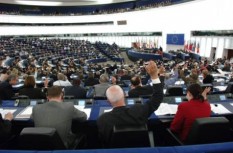
Journalists from across Europe asked the EU court to rule on the hidden records of parliamentarians' allowances.
Twenty-nine journalists, representing all EU member countries, came together in a simultaneous complaint to the European Court of Justice in Luxembourg, inspired by the annual Dataharvest conferences in Brussels. The group, called The MEPs Project (MEP standing for Member of the European Parliament), consisted of individuals who had all tried to obtain documentation of how the elected politicians from their respective countries used their allowances — money granted for various purposes on top of their salaries. In all, the accounts for 751 parliamentarians' allowances were requested. The European Parliament's administration rejected every request on the same three grounds:
- How the money is spent is a matter of privacy, and information cannot be revealed on the ground of data protection.
- The request would be too cumbersome to process, described as an "excessive workload".
- The Parliament is not in fact in possession of relevant documents.
"No basis in EU legislation"
Lawyer Nataša Pirc Musar, Slovenia's former Information Commissioner, was to represent the group in court. She said these arguments did not hold water: "Personal data protection rules were not properly interpreted and the denial of access to requested documents was unjustified." She went on to explain: "By simply denying access to requested documents the European Parliament is effectively granting MEPs the right to secretive public spending and giving them full immunity from public monitoring of their dealings. We argue that the reasons given to the reporters for denying their requests have no basis in any European regulation."
No records — really?
In a written statement, the group cast doubt on the Parliament's claim that documentation for the allowances did not exist: "We believe this fact illustrates perfectly that monitoring of MEPs' spending by the European Parliament is lacking in vigor. By the same token, this fact legitimizes the public's right to know and monitor public spending by this institution." The claim was also contradicted, the group pointed out, by the fact that newly elected MEPs are advised to open a separate bank account to receive their monthly general allowance payments, precisely in order to enable transparent spending.
What the allowances cover
Since 2009 all MEPs receive the same salary, 8,020.53 euro per month. These payments were not part of the case; how an individual MEP uses that money is solely a matter between the MEP, their family and the tax authorities. But on top of their salaries the politicians receive:
- Reimbursement for travel expenses — business-class airfare, first-class rail, or 0.5 euro/km for driving one's own car up to 1,000 km — paid against documented costs.
- A daily subsistence allowance (meals and overnight stay) after proven attendance at meetings — 306 euro per day.
- A general expenditure allowance (phone costs, computers and so on) — 4,320 euro per month.
- Staffing arrangements (assistants in Brussels, Strasbourg and the home country, other than staff employed by the Parliament) — up to 21,379 euro per month, of which 5,344.75 euro may be used for consultancies and other service providers.
These were the claimed costs for which the journalists sought documentation. In all, the Parliament set aside 474 million euro in the 2014 budget for salaries and allowances, seemingly without knowing how a large part of the sum was spent, and unwilling to disclose whatever records existed.
How the project came together
Over the years journalists had repeatedly reported alleged misuse of allowances, such as MEPs using EU money for national campaigns or having family members employed as staff, but the overall picture had been lacking. Anuška Delić, a reporter at the Slovenian daily Delo, took the initiative to form the MEPs Project after she had herself tried to obtain records of how Slovenian MEPs used their allowances. "I got annoyed with the EP's claim about personal data and lawyer Nataša Pirc Musar helped me with the Confirmatory Application (appealing the first rejection). I then thought of the broader approach and talked to those in the upcoming project who were at Dataharvest conference. After the conference I asked journalists I know in different countries, and used journalists Miranda Patrucic's, Marina Walker's and Margot Smit's recommendations for getting to colleagues from countries that were at that point still missing," she said.
"An historic initiative"
A further step came when several participants met at the global investigative-journalism conference in Norway in October, adding others who were not present over a somewhat scratchy Skype connection. Lengthy email threads and cloud-based services were the tools for most of the preparatory work. "In my view the main newsworthiness lies in the mere fact that this is an historic initiative as there has never been a case before where this many journalists would take an EU institution to court over anything, let alone freedom of information," Anuška Delić pointed out. Coordinated news stories on the case were published across several European media platforms from 20 November onwards — a form of semi-syndicated publishing by reporters engaged in a common cause that could itself be seen as a novelty in the media landscape.