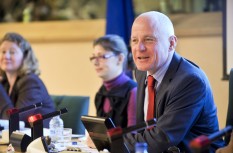
The European Parliament sharpened its resistance to new access rules proposed by the Commission for the EU. At the same time the politicians sought to widen the scope of secrecy for citizens in order to gain better access to documents themselves.
A clash set for Strasbourg
14 and 15 December looked to be crucial dates for future EU access rules. At a plenary session in Strasbourg the 736 members were to debate, and possibly vote on, suggestions recently adopted by LIBE, the committee on Civil Liberties, Justice and Home Affairs. In the committee, rapporteur Michael Cashman (UK, Labour) and others had won backing from most groups, except the centre-right EPP (European People's Party — Christian Democrats), the largest single group in the Parliament and the group forming government in a majority of member states. Of the 20 EPP members in the LIBE committee, 16 signed a minority opinion stating that the majority report went far beyond the goal of transparency and would greatly complicate decision-making.
With 33 votes to 17 in favour of the amendments, the scene was set for a clash between a pro-transparency majority in the Parliament and the civil servants in the Commission, who were likely to be supported by a majority in the Council.
Where Parliament and Commission diverged
The amendments put forward by the LIBE committee would have made important differences in several areas compared with the Commission's proposals:
- Definition of a document (Article 3): the Parliament proposed a wider definition covering any data content, whatever its medium, and all documents held by an EU institution, including data extractable "using any reasonably available tool". The Commission's narrower wording could allow documents to be kept from disclosure simply by not registering them formally.
- Legal advice (Article 4.2c): the Parliament wanted only legal advice relating to court proceedings withheld, adapting the rules to the Court of Justice's ruling in the Turco case (C-39/05), which held that citizens have a right to see legal advice in legislative matters. The Commission generally wanted legal advice kept out of reach.
- Decision-making and "time to think" (Articles 4.3 and 5a): the Parliament wanted documents forming part of the legislative procedure to be accessible in principle, with preparatory documents published online, narrowing the institutions' protected space to think. The Commission favoured wider exceptions where disclosure would undermine decisions.
- Overriding interests (Article 4.4): the Parliament wanted an overriding public interest in disclosing documents relating to fundamental rights or the right to live in a healthy environment. The Commission limited this to information relating to emissions into the environment.
- Privacy and lobbyists (Articles 4.5 and 4.7): the Parliament wanted names disclosed where there was an overriding public interest, especially for documents aimed at influencing policymaking by lobbyists. The Commission referred to the Court's ruling in the Bavarian Lager case (C-28/08 P).
- Veto by member states (Article 5): the Parliament rejected a veto right for member states over disclosure, while the Commission wanted institutions to consult member states before deciding.
- Handling time (Article 8.1): the Parliament wanted confirmatory applications handled within 15 working days, as in the existing regulation; the Commission proposed 30.
- Service to citizens and budget transparency (Articles 14a, 15.1a and 15.2a): on Cashman's initiative the Parliament proposed an information officer in each administrative unit and a database of EU budget documents, where the Commission made no such suggestions.
The wider mechanics of requesting EU documents are set out in the guidance on how to use European freedom of information.
The classification dispute
On classified documents the picture was more muddled. The LIBE committee proposed the same classification rules for all EU bodies as were already used internally in the Council, rules that member states were also to adopt under an intergovernmental agreement. This meant the Parliament would introduce four levels of classification, adding "restricted" to the existing three — top secret, secret and confidential — and would extend secrecy to cover "information which could be disadvantageous to the interest of the Union or of one or more of the member states". Asked how this could be justified, rapporteur Michael Cashman said in October that he was replicating rules that already existed internally in the Council.
From the Parliament's perspective, four levels of classification would put the directly elected politicians on the same footing as diplomats in the Council and civil servants in the Commission when it came to classified information. The proposed Article 3a.3 stated that international agreements could not give a third country or international organisation any right to prevent the Parliament from accessing confidential information. The Parliament would not be kept in the dark; citizens, by contrast, would have to rely on their elected representatives.
A reform negotiated behind closed doors
A further factor complicated the process: the Commission preferred not to hold a general debate and vote on the content of the rules in December, proposing instead a minor change to adapt the existing rules to the Lisbon treaty. Maroš Šefčovič, the responsible commissioner, had, according to different sources, tried to prevent the Cashman report going to plenary, without apparent success.
Were the Parliament to adopt the Cashman report, the incoming Danish EU presidency would place the issue on the agenda for so-called trilogue negotiations between the Council, the Commission and the Parliament in the spring, with the aim of reaching agreement before Cyprus took over in July 2012. This added a further paradox to the question of access rules, since trilogues are negotiations held behind closed doors. The eventual breakdown of these negotiations is recounted in the account of how the reform ended with nobody winning.
Frequently asked questions
What was the Cashman report?
It was the LIBE committee's set of amendments to the EU's access-to-documents rules, steered by rapporteur Michael Cashman. It was adopted in committee by 33 votes to 17 and set up a clash with the Commission ahead of a plenary session in Strasbourg.
Why did the EPP object?
Sixteen of the 20 EPP members on the LIBE committee signed a minority opinion arguing that the majority report went far beyond the goal of transparency and would greatly complicate decision-making.
Why was the classification proposal criticised?
Because, alongside expanding access, it introduced a fourth level of classification and extended secrecy to information deemed "disadvantageous" to the Union or a member state, strengthening the institutions' ability to classify documents.