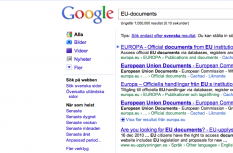
The European Parliament pushed for access to member states' positions in EU documents, but faced an uphill battle. A representative for the Commission suggested the use of Google for those interested in transparency.
A three-year stalemate
Michael Cashman, MEP from British Labour and the main rapporteur — author of the Parliament's report — on access to documents, said the Parliament would formally adopt its position "fairly swiftly, probably before summer." If that were the case, a three-year-long stalemate on access to EU documents might come to an end. Since spring 2008 the three EU institutions — the Commission, the Parliament and the Council — had been bogged down in a low-profile war on the future rules of EU transparency. In 2009 the Parliament took a critical stand against the new rules proposed by the Commission the year before. This criticism was repeated in 2010, shortly before the EP election. But the final vote on Mr Cashman's report was still to be taken.
The Parliament's Committee on Civil Liberties, Justice and Home Affairs (LIBE) had deliberately waited to make its position formally known. The Committee had thus hoped to be engaged in a so-called trilogue negotiation with the Council and the Commission, formally known as negotiations for a first-reading agreement. In such negotiations, conducted behind closed doors, the Parliament has more power than if the process proceeds with two or more readings in the open. But this hope of a short track had not been met. Neither of the other two institutions wanted to go into a trilogue on access rules. They stood firm on the proposal from 2008, and showed no interest in giving in to the Parliament, save for a pro-transparency minority of between five and seven member states in the Council.
"Lisbonising" the access rules
Nevertheless, a hearing organised by the LIBE committee in Brussels on 13 April showed signs of the process gaining momentum, as indicated by Michael Cashman. This momentum seemed to gain speed from a second proposal by the Commission to instantly make some limited changes to the access rules in order to meet the requirements of the Lisbon treaty: there should be clear references to the new treaty in the access regulation, and it should be spelled out that the rules cover all EU institutions and not only the Commission, Parliament and Council, the Commission proposed. To some member states this "Lisbonising" of the present rules could be adopted quickly without too much fuzz. Other actors were not so sure.
Tony Bunyan, head of the civil rights watchdog Statewatch, said now was the time to make a clear break with one of the central exceptions to access in the EU system. "Lisbonising is a good chance to get rid of the exception of access of documents that would seriously undermine the decision-making process," he said.
This exception (article 4.3), once coined by the Commission as a needed "space to think" for EU institutions, was often used to withhold member states' positions before an EU law had been adopted. "The exception had a basis in the Amsterdam treaty, but after Lisbon has come into force it's not longer treaty based," Tony Bunyan added at the hearing.
Deirdre Curtin, professor in EU law, came close to the same conclusion. "The Lisbon treaty puts emphasis both on access to documents and the right of citizens to participate in the democratic process. We need the principle of openness in the lawmaking even more as the EU is not a fully representative democracy," she said.
Revealing member states' positions
A third voice singing the same tune was that of Heidi Hautala, Finnish MEP from the Greens and rapporteur on the Annual Report on public access to documents for 2009–2010. Hautala had published four working documents on the function of the present rules. She concluded that legislative transparency, "especially in the framework of Council working groups", must be fully established. That meant revealing member states' positions.
Hautala believed that the major overhaul of the present rules first suggested in 2008, and the proposed "Lisbonising" put forward that year, could be conducted at the same time, but admitted to being uncertain of the outcome: "The main principle in the Lisbon treaty says that everything is accessible, but we can see how the Commission and many Member States want to undermine this rule. If we look at the present rules it's clear that they are better than the Commission's suggestions," Heidi Hautala said.
The rapporteurs, including Finnish liberal Anneli Jäätteenmäki, were pushing for action, most likely by taking the formal vote on the Parliament's position before summer 2011. In doing so they faced an uphill battle, especially since they wanted to include common classification rules for sensitive documents in the revision. This would mean that parliamentarians — if only a selected and security-vetted group — would get access to top-classified documents from the Council. To many member states this was a repulsive idea. Related developments were traced in the account of how EU governments resisted revealing their positions.
"A system I use myself is to google for documents"
The lack of interest from the Council in the matter of transparency was shown at the Brussels hearing by the absence of representatives from both the then Hungarian and the upcoming Polish EU presidencies. Hubert Szlaszewski, representing the responsible Commissioner Maroš Šefčovič, told the committee that he himself had only dealt with access to documents for two weeks, but said he did not find the situation as bad as indicated by other speakers at the hearing. "A system I use myself is to google for documents," Mr Szlaszewski advised the audience. General guidance on making such requests is set out in how to use European freedom of information.
Frequently asked questions
Who was the Parliament's rapporteur on access to documents?
Michael Cashman, an MEP from British Labour, was the main rapporteur and author of the Parliament's report on access to documents. He said the Parliament would formally adopt its position "probably before summer."
What did "Lisbonising" the access rules mean?
It referred to a Commission proposal to make limited changes so the access regulation clearly referenced the Lisbon treaty and stated that the rules covered all EU institutions, not only the Commission, Parliament and Council.
What was article 4.3 of the access regulation?
Article 4.3 was an exception once described by the Commission as a needed "space to think" for EU institutions. Critics said it was often used to withhold member states' positions before an EU law had been adopted.