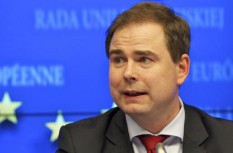
A leading member of the European Parliament called the Danish outline on new transparency rules unacceptable, but signalled a readiness to look at what some described as abusive use of access by lobbyists and lawyers. The Danish minister responded to the Swedish criticism: diversity of opinions was a well-known fact, but the presidency would work hard to achieve a result.
A leaked but withheld proposal
Backed by a majority of member states, the EU presidency prepared to engage in informal discussions with the Parliament on new rules for access to EU documents. The proposal, said to enhance transparency, was not to be seen by the European public: its content was marked N/A — not accessible — in the Council's document register. The document was nevertheless in the open, thanks to the London-based documentation centre and civil-rights organisation Statewatch and to the transparency campaigner Access-Info Europe in Madrid. Statewatch director Tony Bunyan had appealed the decision not to officially release the central document of the dossier. Before the mandate was given, Sweden and Finland announced that they would not back the proposal.
"A well known fact"
Swedish minister of justice Beatrice Ask, a conservative, had described the outline as even worse than the proposal put forward by the Commission in 2008, in an earlier comment. She underlined her position in a letter to the Parliament's transparency rapporteur, Michael Cashman (UK, Labour): "I am certain that you will continue to strive for more transparency and I sincerely hope that we will continue to cooperate closely on this dossier." Danish minister of European affairs Nicolai Wammen, a social democrat, reacted to the criticism in a written statement: "It is a well known fact that there is a big diversity of opinions on the need for openness in the EU – both internally in the Council and between the Council and the Parliament. Now there is a real possibility to negotiate a recast of the existing rules, in accordance with the Lisbon Treaty, and the last 10 years of case law. We will from the Danish side try to take as big advantage of this possibility as possible."
An act of balance
Wammen went on to say that the presidency would work hard for a result that kept the present very high standard of openness in the institutions while making necessary updates to the rules: "This is, and will be, a very difficult act of balance. A result will under all circumstances demand that all parties involved are prepared to join in, in order for us to reach good, pragmatic and well functioning solutions. This is our point of departure for negotiations with the Parliament." While Wammen played down the Swedish criticism, MEP Michael Cashman returned Ask's message: "My official answer to the minister is that yes you can rely on the Parliament. We will not diminish the current access and the openness that we have."
"Unacceptable"
Cashman made clear that the proposal as it stood would not be accepted by the elected EU politicians: "I think the Parliament apart from the Christian Democrat is fairly united. The mandate from the Council is not acceptable, and we are quite clear that we can not revert the Turco judgement on access (right to see legal advices), there cannot be block exemptions (categories of documents kept secret), and member state veto. Also the new definition of a document is unacceptable." Those examples would, if adopted, reduce transparency compared with the existing regulation. At the same time the proposal explicitly stated, in article 12.2, that documents relating to EU legislative acts should be made directly accessible to the public. Asked how that squared with the exemptions, Cashman said: "You are right that the flag is up as article 12.2 is worded. These documents shall be made available, direct access that is. We have to be absolutely clear that any attempt to introduce new exceptions or derivations, do not undermine the access we have got."
"Utterly unjustifiable"
Further arguments could be found in an analysis of the presidency's proposal by Steve Peers, professor of law at Essex University and associated with Statewatch. After an article-by-article examination of the secret but leaked document, Peers found that the Council's draft position constituted a significant overall reduction in the level of access to documents. "In particular, the council's definition of a 'document' is of doubtful legality and would exclude massive numbers of documents from the scope of the rules," he noted, adding: "Conversely, given that the 2001 Regulation already exists, it would be profoundly foolish and utterly unjustifiable for the EP to agree to a new Regulation which amounts to an overall reduction in the current level of access to documents."
Some abusive use
Given those assessments, the question was what remained to negotiate. Cashman said: "However having said that (the proposal being unacceptable), 11 years on from when we wrote the present regulation we should try to look at what some call abusive use of the legislation by lobbyists and lawyers, which is used for a commercial gain. This might mean looking at certain files whereby you could look at protection some of that information, if its release were to undermine similar investigations or audits in the future." He continued: "To be honest I heartily believe if the current regulation were intelligently applied it could deal with these issues, but the Council and the Commission believes otherwise. In a nutshell what I'm saying is 11 years on, of course there has been some abusive use of the regulation but by and large it works extremely well. I originally said it is organic law. So that's why we need to negotiate with them. And the strength that the Parliament has, is that if there is not an agreement we have the current regulation to fall back on."
Agree, or reject
On the Parliament's power to back its views, Cashman said: "The two institutions (the Council and the Parliament) are co-legislators. They have to agree. If no agreement then the EP can reject the proposal and the whole thing falls. The Commission and others argue that we have to amend it so that the Lisbon Treaty has an effect within the regulation. I don't accept that. And the legal service at the Parliament does not believe that is legally essential. The Lisbon Treaty has a legal effect now." Wammen, speaking for the presidency and the Council majority, stressed that the task was difficult and gave an open-ended comment on the likely outcome: "If we succeed in getting a result, this will mean that Denmark has made sure that openness in all EU-institutions will be secured for the future to the benefit for all citizens and enterprises in daily touch with the EU-cooperation."
In times of crisis
On the consequences of failure, Cashman offered a warning to member states' governments: "Unless people understand and see what is done in their name, they will never give their trust, and we need their trust now more than ever. When things are easy people forget what's going on. When things are difficult they do know what's going on, and sadly they look for the scapegoat. In times of political and economic crisis its even more important to bring citizens closer to the Union." Steve Peers also had a warning, addressed to the Parliament: "In particular, the EP should make clear to the Council that it cannot in any circumstances accept the proposed definition of a 'document'. If the Council is adamant on including this definition, the EP should instantly veto the proposal."
Frequently asked questions
Why was the proposal called unacceptable?
Rapporteur Michael Cashman said the Council's mandate would reverse the Turco judgement on access to legal advice, allow whole categories of documents to be kept secret, introduce a member-state veto and redefine what counts as a document — each reducing access compared with the 2001 regulation.
What did the Parliament say it might negotiate?
Cashman indicated openness to examining what some called abusive use of the rules by lobbyists and lawyers for commercial gain, while insisting the existing regulation largely worked well and remained the fallback if no agreement was reached.
What leverage did the Parliament hold?
As co-legislators, the Council and Parliament had to agree; without agreement the Parliament could reject the proposal and it would fall. For background on access rights, see how to use European freedom of information.