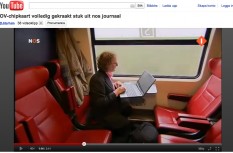
A Dutch journalist, Brenno de Winter, showed on television how easy it was to cheat a new electronic payment system for public transport. The prosecutor took up the case, in order to decide whether the journalist should be prosecuted for fraud.
Mary Hallebeek, press officer at the prosecutor's office in Utrecht, described the case as delicate: "The journalist did this to show that the system doesn't function well, and he had been telling this in different publications before. We are aware of that he had a journalistic purpose, and the purpose of an act should be considered according to Dutch law," she said. She added that the investigation was triggered by a notification to the prosecutor's office by Trans Link Systems, the company designing the payment system, but noted that the prosecutor was also aware of the alleged fraud through the media.
Brenno de Winter said he did not see another way of proving claims about the weaknesses of the system, mainly because the company behind the system had refused to answer direct questions. Several other journalists joined him in his research and published their results. Police questioned none of them, and the public prosecutor's office indicated that no other reporters were in the scope of a possible prosecution. "I'm a freelance journalist whereas the other journalists have regular employments. So to be singled out hits me harder than it would hit the national news," de Winter said.
A publicly funded payment system
The core of the case was a digital payment system for public transportation, a project mainly funded with public money and carrying a large price tag.
De Winter argued that the technology used was highly insecure and that several scientific studies had warned of the risks of using the card as a payment system. A decision to carry on was made on the promise that fraud would easily be detected and that fraudulent cards would be blocked after a maximum of 24 hours.
Earlier in the year, de Winter showed that people with basic computer knowledge were capable of defrauding the system, using standard tools available on the Internet. He also showed that this could be done without the system detecting the attempts, and that cards generally were not blocked. He further demonstrated that using a card that had already been blocked was still possible without being discovered by the system. "The central systems turned out to fail in all thinkable ways," de Winter claimed.
The seemingly vulnerable payment system had attracted significant attention in the Dutch media, and the revelations were debated in Parliament. At the prosecutor's office, Hallebeek said that a decision on whether to prosecute, and if so on what grounds, would most likely be taken within a week or two.