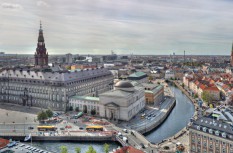
Danish parliamentarians prepared to adopt a new access law that would keep politically sensitive documents secret by definition. Critics called the "Yes-Minister-law" undemocratic and outrageously arrogant.
Warnings from legal experts
Denmark's reputation as a pro-transparent country was at stake, warned leading media-law expert Oluf Jørgensen: "This will draw international attention," he said, pointing to a unique possibility to conceal reports from a minister to a closed circle of parliamentarians — "This is in clear breach with the principle of division of powers." Tim Knudsen, a professor of political science, offered a similar comment: "Slotsholmen (home of the parliament and governmental departments on a tiny island in Copenhagen) shields itself and weakens democracy."
The comments were triggered by proposed new legislation on access to official documents. One single paragraph caused the uproar: "The right of access does not include internal documents and information exchanged at a time when there is specific reason to believe that a minister has or will have a need for the advice from an civil service and assistance between: 1) A ministry department and its subordinate authorities. 2) Various ministries."
An agreement culture
In a previous version, tabled by the then liberal-conservative government, the clause was explicitly called an exemption for "services to ministers". It should not be confused with the "internal working papers" familiar from many access laws, since the exemption covered documents in their final version as well as documents sent between different ministerial departments and authorities. When the proposal was re-tabled by the sitting centre-left government, the provocative and ridiculed term "services to ministers" was deleted. Minister of justice Morten Bødskov (Social Democrats) argued the change of wording was important, while representatives of the former government failed to see any change in substance. The urge among Danish politicians to ring-fence correspondence between authorities and ministers could be explained by an established culture in which parties enter pre-legislative negotiations and agreements before proposals are officially tabled — a culture demonstrated at length by how the proposed law itself was handled. The same "service to ministers" exemption is examined in a report on the lowered curtain around government.
Behind closed doors
As journalists became aware of what was in the making, they asked for access to documents related to the secretive talks between the former and the present government. This was denied. Suggestions to make the new proposal subject to an official hearing were also rejected. "This is outrageously arrogant," said Pernille Skipper, an MP of the Red-Green Alliance, a leftist party that formed part of the government's platform in parliament. The right-wing Danish People's Party and Liberal Alliance opposed the proposal as well. None of the three parties had themselves held governmental positions, in contrast to the parties backing the law.
A parallel to the EU
According to the critics, several well-known recent political affairs would most likely not have become public had the proposed law been in force. These included deliberate attempts by the previous government to bypass international conventions on refugees, and an ongoing case concerning prime minister Helle Thorning-Schmidt's personal taxes, in which members of the former government were suspected of having intervened in decisions by the tax authorities in order to discredit a political opponent. Despite the strong criticism, it was assumed the proposal would pass parliament later in the spring, as a majority of parties had already agreed to adopt it. Observers familiar with the EU process recognised a parallel to the so-called trilogues, or three-way negotiations, in which the Commission and the Council negotiate with representatives of the Parliament behind closed doors, leaving the public in the dark and non-participants only to accept a done deal.
Frequently asked questions
What is the "Yes-Minister-law"?
It was a nickname critics gave to a proposed Danish access law containing a clause that would keep internal documents and advice exchanged around ministers secret by definition, covering communication between ministry departments and between different ministries.
Why did critics object so strongly?
They argued it breached the separation of powers, would shield ministers from scrutiny and had itself been prepared through secretive talks, with requests for access and for an official hearing both refused.
How does it relate to EU practice?
Observers compared it to EU trilogues, where the Commission, Council and Parliament negotiate behind closed doors. For background on access rights, see how to use European freedom of information.