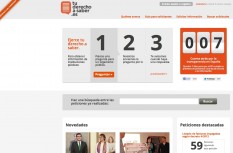
People in Spain became able to make and track requests for information from public bodies through a new web portal, TuDerechoaSaber.es ("Your right to know"). The site launched with hopes that it would be followed by a long-awaited access-to-information law. It was set up by the human-rights organisations Access Info Europe and Fundación Ciudadana Civio, in the expectation that the Spanish government would adopt an access-to-information law during the first half of 2012.
Breaching the wall of silence
"The website aims to breach the wall of silence between the administration and the public. It will make it easy to ask about current topics such as cuts in public services or the debts of political parties," said Victoria Anderica, campaigner and project coordinator with Access Info Europe. With the portal, she said, asking for such information was as easy as sending an e-mail.
Spain without an access law
Spain was the only EU country with more than one million inhabitants that had no access-to-information law, and research showed that over one in two requests — 54 per cent — never received any kind of response, while only 20 per cent obtained the information requested. "At present, each public body can decide arbitrarily whether to make information public," said David Cabo, founder of Fundación Ciudadana Civio. He said this would change with a law that required responses within a fixed timeframe, and that the aim was for the public, not the administration, to decide how much transparency there would be.
The Spanish government had committed to present a law on transparency, access to information and good government at the meeting of the Open Government Partnership in Brasília on 17 April. Once adopted, Access Info Europe, Fundación Ciudadana Civio and members of the public would be able to monitor the implementation of the new law through the TuDerechoaSaber.es website.
Modelled on the UK example
TuDerechoaSaber.es aimed to mirror the success of the UK website Whatdotheyknow.com, built by the UK organisation mySociety, which had processed more than 100,000 requests over four years — around 15 per cent of all requests in the United Kingdom, which had had an access-to-information law since 2005 — demonstrating the high demand for transparency. Both websites used the same Alaveteli open-source software. Other similar platforms included AsktheEU.org, for requests to the European Union, built by the same team as TuDerechoaSaber.es, and request websites in Germany, Kosovo, Chile and Brazil. Related coverage is collected under WhatDoTheyKnow.
Frequently asked questions
What is TuDerechoaSaber.es?
It is a Spanish web portal, launched by Access Info Europe and Fundación Ciudadana Civio, that let people make and track requests for information from public bodies as easily as sending an e-mail.
Why was the portal needed?
Spain was the only EU country with more than a million inhabitants without an access-to-information law, and 54 per cent of requests received no response at all, while only 20 per cent obtained the requested information. For background on making such requests, see how to use European freedom-of-information laws.
What software does it run on?
It uses the same Alaveteli open-source software as the UK site Whatdotheyknow.com, built by mySociety, and as sister platforms such as AsktheEU.org and request sites in Germany, Kosovo, Chile and Brazil.