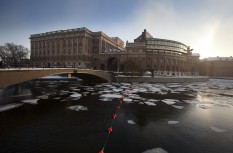
The Swedish parliament, Riksdagen — which in 1766 saw the birth of the first law on freedom of information ever — adopted a new limitation on access to documents. Documents may be withheld in order not to "deteriorate" Swedish interests in international relations.
The new ground for classification was introduced by a decision in parliament on 21 November. Two parties, the Greens and the Left Party, voted against. The centre-right government, as well as the Social Democrats in opposition, claimed that the law revision should not be seen as a backlash for transparency, but rather a technical adaption to an increasing amount of international negotiations and other forms of international cooperation. The Greens and a few interest groups and stakeholders disagreed. They feared the new rule would function as a slippery slope towards more secrecy, and would weaken arguments in favour of openness when presented by Swedish officials in the EU. Sweden's long transparency tradition is set out in the account of how the world's oldest access law would remain.
To be well defined
For centuries Sweden has adhered to the notion of an open administration. Documents are supposed to be available to the public unless stated otherwise. This has led to a steadily growing list of secrecy clauses as exceptions to the general rule. The bottom line, though, still reads a presumption for access, and all exceptions have to be well defined by the law. This is where the new controversy kicks in.
As most nations do, Sweden has a clause for secrecy in order not to "disturb international relations" or in other ways "harm national interests." This clause remains, with the following added on top: secrecy shall also apply when "it can be assumed" that Sweden's ability to participate in international cooperation "deteriorates" if the information is disclosed.
Margin for denial
The critics stressed two essential aspects of the new clause expanding secrecy. To "be assumed" is an extremely vague term, and the same goes for "deteriorates". Both terms leave a wide margin for public authorities not to reveal information, just to be on the safe side.
The new secrecy clause also meant that Sweden de facto gave away the supremacy to decide on an access request to the EU or to other EU member states. Such a provision runs counter to arguments previously carried by Swedish politicians and civil servants in negotiations about the EU's own access rules, where Sweden had argued fiercely not to give an emitter of a document a veto right over its release, often referred to as "originator's right". Those EU negotiations are traced in the account of how the revised access rule was to be kept in the freezer.
Crusade has been cancelled
The originator's right was now introduced in Swedish law with explicit references to EU legislation and agreements between the EU and third parties. In the final debate in Riksdagen, MP Peter Eriksson (the Greens), chair of the Constitutional Committee, said: "The Swedish crusade for openness is apparently cancelled. It is replaced by handing out rubber stamps for secrecy to be used deliberately. This is tragic and a betrayal of close to 250 years experiences." The Left Party announced in the final debate that it would second the Greens' motion for rejecting the proposal.
Frequently asked questions
What did the new Swedish secrecy clause allow?
It allowed documents to be withheld when it "can be assumed" that Sweden's ability to participate in international cooperation would "deteriorate" if the information were disclosed, adding to the existing clause on international relations and national interests.
Who opposed the new clause?
The Greens and the Left Party voted against, together with a few interest groups and stakeholders. The centre-right government and the Social Democrats described the change as a technical adaption rather than a backlash for transparency.
What is the "originator's right" mentioned in the debate?
The originator's right lets the emitter of a document hold a veto over its release. Critics said the new clause effectively handed such power to the EU or other member states, contrary to positions Swedish representatives had previously defended in EU negotiations.