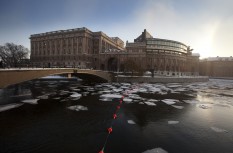
Swedish parliamentarians unanimously agreed not to propose a recast of the Swedish Freedom of the Press Act, the first law in the world to grant citizens access to public information.
A unanimous decision to keep the old laws
Backed by overwhelming public opinion, politicians from all parties in the Parliament except one — the right-wing Swedish Democrats, who were not present — decided not to put forward a suggested overhaul of the country's historical press law of 1766 and the much younger Fundamental Law on Freedom of Expression of 1991, which covers broadcast media. The decision was taken by a preparatory committee that had been given the task of investigating possible changes to the laws. The committee decided to keep essentially to the existing legislation, partly setting aside the instructions given to it by the government.
Those instructions had been to investigate whether the historical laws had been outdated by new media forms such as web portals, blogs and text messages, and to find ways to reduce areas of conflict between Swedish law and EU legislation. The members felt the price of replacing the existing laws would be too high. There was widespread concern in the committee that new legislation would be harder to defend if criticised in an EU context, and that it would weaken existing rights for citizens. "The committee was asked to reinvent the wheel, so it did and decided to give it a round shape," commented Nils Funcke, one of the committee's secretaries, in a blog post (in Swedish only).
Why the Swedish laws are atypical
The concern in the committee stemmed from the fact that the Swedish media laws are atypical, and sometimes considered extreme, compared with similar legislation in other countries:
- Access to official documents is a constitutional right and a general presumption, although many exceptions for secrecy exist in other laws.
- The laws prohibit all kinds of censorship.
- The laws contain a form of whistleblower right for public servants ("meddelarfrihet" — freedom to pass information), which makes it a constitutional crime to investigate any oral leak from a public institution, though leaking classified documents remains a crime.
- In court cases on freedom of expression only the publisher can be punished — never the journalist or writer, the printer or others involved — and special court rules deliberately make it difficult for the prosecutor to obtain a conviction.
A continuing conflict with EU law
These conditions had on several occasions given Swedish governments difficulty in the EU, forcing them to ask for constitutional exceptions from EU law. Incitement to terrorism, for example, is a crime defined by an EU framework decision adopted in 2008, yet it was more or less protected from prosecution by the Swedish law on freedom of expression. A more recent example was a proposed new regulation on data protection, which threatened to override the Swedish approach to access to information. The general mechanics of requesting official documents are set out in the guidance on how to use European freedom of information.
The committee's decision not to propose drastic changes would not make the conflicts with EU legislation disappear. But the unanimous outcome indicated that the elected politicians were prepared to take each battle as it came in order to defend access rights and the other specific conditions, rather than adopt more EU-streamlined legislation. Comparable friction over EU-level access rules is examined in the account of sharpened conflicts on new access rules. The committee maintained its own website (in Swedish only), where no reference to the decision not to propose new legislation could be found.
Frequently asked questions
What is the Swedish Freedom of the Press Act?
Dating from 1766, it was the first law in the world to grant citizens access to public information. Alongside the Fundamental Law on Freedom of Expression of 1991, it forms the core of Sweden's media law.
Why did the committee keep the existing laws?
The members felt the price of replacing them was too high, fearing that new legislation would be harder to defend in an EU context and would weaken existing rights for citizens.
What makes the Swedish media laws unusual?
Access to official documents is a constitutional right, all censorship is prohibited, public servants enjoy a right to pass information ("meddelarfrihet"), and in freedom-of-expression cases only the publisher can be punished.